Developer Marketing on a Budget: A Solo Founder's Playbook

Developer marketing on a budget works when you replace ad spend with things developers already trust: clear documentation, coding tutorial videos, honest build-in-public updates, and real participation in the communities they already read.
None of it requires a team. Most of it requires a laptop, a screen recorder, and a habit of shipping content as often as you ship code.
If you’re a solo founder trying to get a dev tool in front of developers, you already know the uncomfortable truth: developers can smell a marketing budget from a mile away, and they actively route around it.
Ad blockers, banner blindness, and a general allergy to “revolutionize your workflow” copy mean that outspending your competitors was never really an option, even if you had the cash.
The good news is that it was never really necessary either. Developers reward tools that show their work. That’s the whole playbook.
Why Developer Marketing Doesn’t Work Like Other B2B Marketing
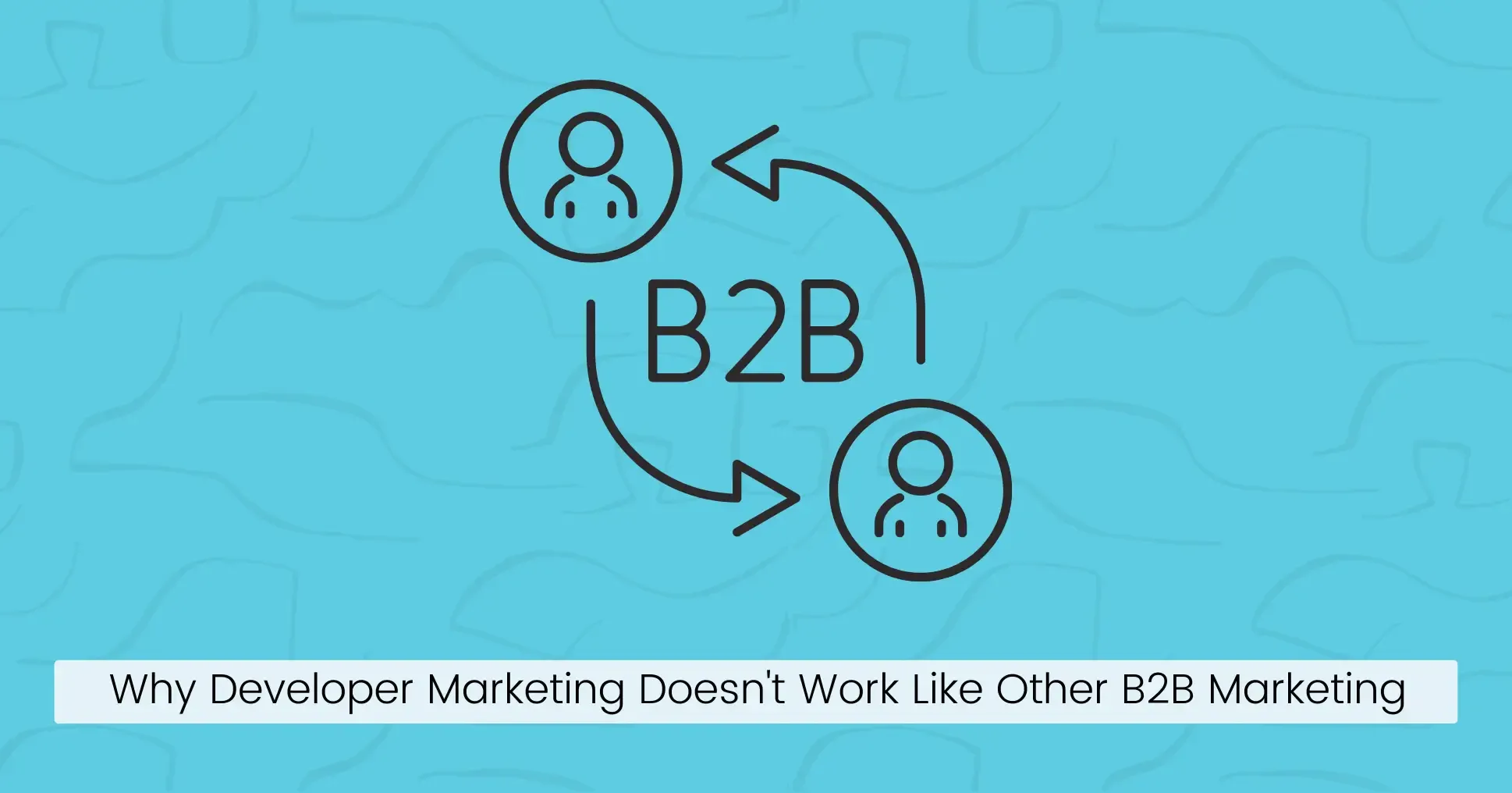
Developers are the hardest B2B audience to advertise to and the easiest to earn their trust if you approach it the right way.
- They skip ads by default. Browser extensions, ad blockers, and years of being pitched to have made most developers immune to typical funnel tactics.
- They trust artifacts, not adjectives. A working code sample, a real changelog, or an honest comparison table earns more credibility than any headline claiming to be “the future of X.”
- They can tell when content was written by someone who has never opened a terminal. Generic, keyword-stuffed content gets ignored, fast.
This isn’t bad news for a solo founder. It’s the opposite. It means the channels that work best for developer marketing on a budget, content, community, and product-led proof, are also the cheapest ones to run.
The Solo Founder’s Developer Marketing Framework

Before the tactics, here’s the shape of the whole strategy. Every solo founder doing this well is really running four overlapping loops:
- Create something worth sharing (a tutorial, a snippet, a build-in-public update).
- Package it so it’s actually watchable or shareable in under a minute of attention.
- Distribute it in the two or three places your specific developers already spend time.
- Repeat on a schedule you can actually sustain solo, not one built for a five-person content team.
Everything below fits into one of those four steps.
1. Make Coding Tutorial Videos Your Core Content Format
If you only have time for one content format, make it video.
Short, focused coding tutorial videos consistently outperform long blog posts for both reach and trust, because they let a developer watch your product actually work instead of taking your word for it.
Keep it simple:
- Pick one narrow problem per video (“add dark mode in 3 lines,” not “everything about theming”).
- Aim for 60 to 180 seconds for social platforms, and save the 10-minute deep dive for YouTube or your docs.
- Show real code, not slides. Developers scroll past anything that looks like a sales deck.
- Post the same video natively to X, LinkedIn, YouTube Shorts, and TikTok if it fits. Native uploads outperform links to external video every time.
This is also where a code-visual tool earns its keep.
Writing and recording code live on a messy IDE theme doesn’t read as “polished,” it reads as “unfinished.”
A dedicated tool like Snappify lets you animate code snippets, highlight the exact lines that matter, and export the whole thing as an MP4 or GIF without touching a video editor, which is the difference between a tutorial that looks like a screen recording and one that looks like a product demo.
Its video export feature was built specifically for this kind of short, code-first clip, or you can use screen recording tools.
2. Turn Every Snippet and Doc Page Into Shareable Visual Content
One good explanation should never live in only one place. If you wrote a helpful answer in a support thread, a clean function in your docs, or a “before vs after” refactor, that’s a reusable asset.
- Convert a docs page into a carousel of code screenshots for X or LinkedIn.
- Turn a changelog entry into a single annotated snippet showing what changed and why.
- Embed interactive code snippets directly in your blog posts so readers can copy the code without leaving the page, which keeps them on your site longer and signals real technical credibility.
This is a low-effort, high-frequency habit, and it’s the exact use case tools like Snappify are built around: create one snippet once, then reuse it as a social post, a blog embed, and a slide in your next talk.
Its embedding support for Notion, Medium, and Hashnode means the same visual can live inside your blog and still let readers copy the underlying code, instead of shipping a flat screenshot nobody can actually use.
3. Go Where Developers Already Talk
Community-led distribution is the single highest-ROI channel for marketing to developers cheaply, because it costs time, not money. It’s also the easiest channel to get wrong if you show up only to pitch.
Solid starting points for most dev tools:
- Reddit communities relevant to your stack (r/webdev, r/SaaS, r/selfhosted, or a niche subreddit for your exact language or framework)
- Hacker News, especially “Show HN” for launches and technical write-ups
- dev. to and Hashnode, both of which reward genuinely useful, well-formatted technical posts
- Niche Discord and Slack communities built around the framework or category you serve
- GitHub Discussions and issues on adjacent open source projects, where being helpful builds real reputation
The rule that keeps this sustainable: answer ten questions for every one time you mention your own product. Community trust compounds slowly and disappears instantly.
4. Build in Public, Consistently
Sharing your actual numbers, decisions, and mistakes does two things a polished announcement never can: it’s inherently more interesting, and it’s nearly impossible for a big competitor to copy convincingly. Solo founder marketing to developers works best when it reads like a person, not a brand account.
- Share specific numbers (signups, MRR, churn, a bug you just fixed) rather than vague progress updates.
- Post the ugly middle, not just the launch day. Developers relate to the debugging story more than the highlight reel.
- Cross-post build-in-public updates to Indie Hackers, X, and your own changelog so each post works three times.
This is also where coding tutorial videos and build-in-public naturally overlap: a 90-second clip of you fixing a real bug or shipping a real feature is both content and proof of momentum.
5. Borrow DevRel Tactics Without a DevRel Budget
You don’t need a Developer Relations team to think like one. It’s worth knowing that even companies with dedicated DevRel programs don’t spend most of their budget on advertising.
The low-budget DevRel moves that translate directly to a solo team:
- Write one genuinely useful, in-depth technical guide a month instead of ten shallow posts.
- Contribute a real fix or feature to an open-source project your users depend on.
- Run a free, small, focused livestream or office hours session instead of a paid webinar funnel.
- Guest post on a blog your target developers already read, rather than buying a sponsorship.
6. Write for Search Engines and Answer Engines at the Same Time
SEO still matters, but increasingly your content also needs to be the kind of thing an AI answer engine can lift a clean, accurate paragraph from.
That means:
- Answer the actual question in the first two sentences of a section, then explain.
- Use real headers that match how people search (“how much does X cost,” “is X better than Y”), not clever ones.
- Back up claims with a specific number and a link, not a vague adjective.
- Keep FAQs on the page itself. Structured, direct Q&A content gets pulled into both search snippets and AI-generated answers.
7. Measure What Actually Moves the Needle
Views and likes feel good and mean very little on their own.
For bootstrapped SaaS developer content, track:
- Signups or trial starts attributed to each content piece or channel.
- Which specific videos or posts drove replies, DMs, or community mentions, not just impressions
If a tactic isn’t producing at least one of those after a genuine month of effort, drop it and double down on what is.
Solo founders don’t have the runway to keep three underperforming channels alive out of habit.
FAQs:
Are coding tutorial videos actually effective marketing for a dev tool?
Yes. Short-form video currently delivers the highest ROI of any content format according to recent marketing benchmark data, and for a technical audience specifically, watching code work in real time builds more trust than any written claim about a product.
How long does it take to see results from bootstrapped developer content marketing?
Most solo founders see early signals, replies, community mentions, and small signup bumps, within four to six weeks of consistent posting. Meaningful, compounding traffic from SEO and video usually takes a few months, which is why tracking signups per piece matters more than judging any single post in isolation.